



TEL

Search


Connecting plastic pipes traditionally often requires heat fusion. This method requires specialized fusion machines and high operator expertise.
Risks such as overheating or "cold fusion" joints can lead to structural failures, while working in confined spaces becomes nearly impossible. Furthermore, heat-fused joints cannot be disassembled or reworked.
Is there a better method? Polypropylene (PP) compression fittings have emerged as a "heat-fusion-free, detachable, fast, and reliable" connection solution. Read on for more about PP fittings and their uses.
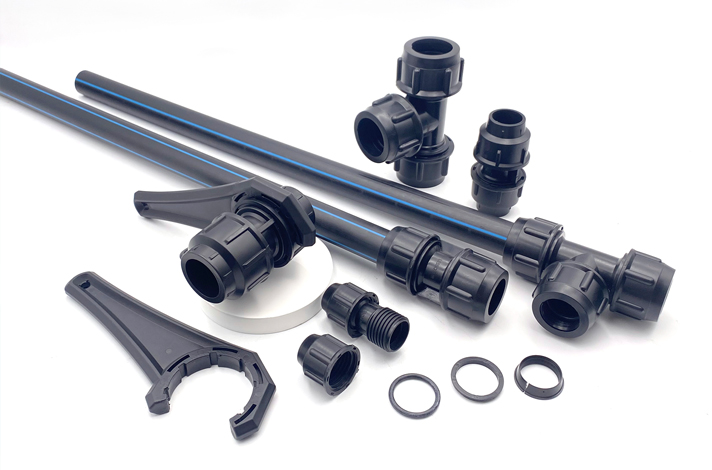
PP compression fittings are mechanical joints designed specifically to connect PP pipes. These PP fittings utilize a "push-fit" mechanism combined with a threaded nut to create a watertight seal.
The structural integrity of a compression coupling relies on five core components:
l Main Part: Connects pipes and houses internal components, providing attachment points for the nut.
l Sealing Gasket: Seals tightly against the pipe surface to prevent water or liquids from leaking at the connection.
l Thrust Ring: Provides mechanical grip to prevent the pipe from being pulled out under pressure.
l Clamp Ring: Helps secure the pipe and evenly distribute pressure to the sealing gasket.
l Nut: An external fastener that creates sealing pressure when tightened.
The shift toward PP fittings in modern infrastructure is driven by several distinct advantages:
Installation of PP compression fittings is quick and largely tool-free for smaller diameters. Because it does not require electricity or specialized fusion equipment, it allows for single-person operation and avoids fire risks and toxic fumes.
Most importantly, these PP fittings can be installed easily in confined or hard-to-reach spaces where a fusion machine cannot go.
Unlike permanent fusion or solvent-cemented joints, a compression coupling is fully detachable. If a system needs to be moved or a pipe needs replacement, the nut can be unscrewed and the fitting reused.
This makes polypropylene compression fittings the perfect choice for temporary setups or seasonal agricultural systems.
Because they are made from high-quality polymers, PP fittings avoid the rust and scale that are common for metal connectors. They resist most acids, alkalis, and salts, ensuring that the water quality remains uncontaminated for years to come.
Designed for durability, PP compression fittings can accommodate minor pipe movements and thermal expansion without losing their seal. When used within their rated pressure, these fittings provide decades of maintenance-free service.
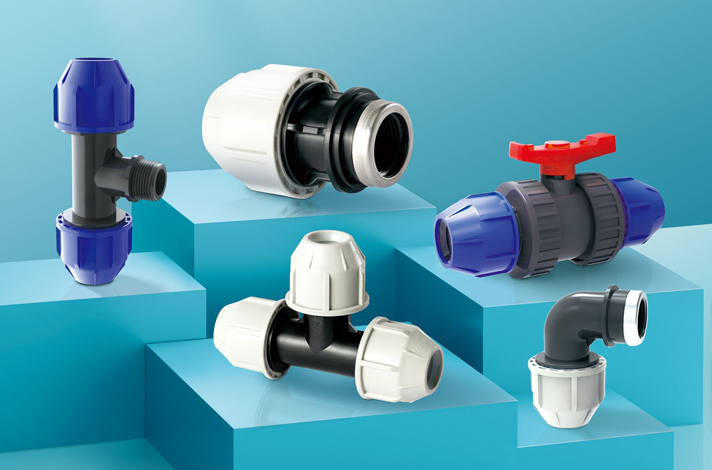
To accommodate complex piping layouts, PP compression fittings come in a variety of configurations:
l Couplers: The most standard compression coupling, used to join two straight sections of pipe of the same diameter.
l Elbows: Used to change the direction of the pipeline, typically at 90° or 45° angles.
l Tees: Used to create a branch in the pipeline, allowing fluid to flow in three directions.
l Reducers: Specialized couplers that connect pipes of different diameters.
l Valves and Adapters: These include valves for flow control and threaded adapters that allow PP fittings to transition to metal valves or existing PVC systems.
The versatility of PP compression fittings allows them to be used across diverse industries:
Because they are often certified for potable water, these fittings are widely used in home plumbing. They provide a safe, leak-proof method for delivering drinking water without the need for chemical glues.
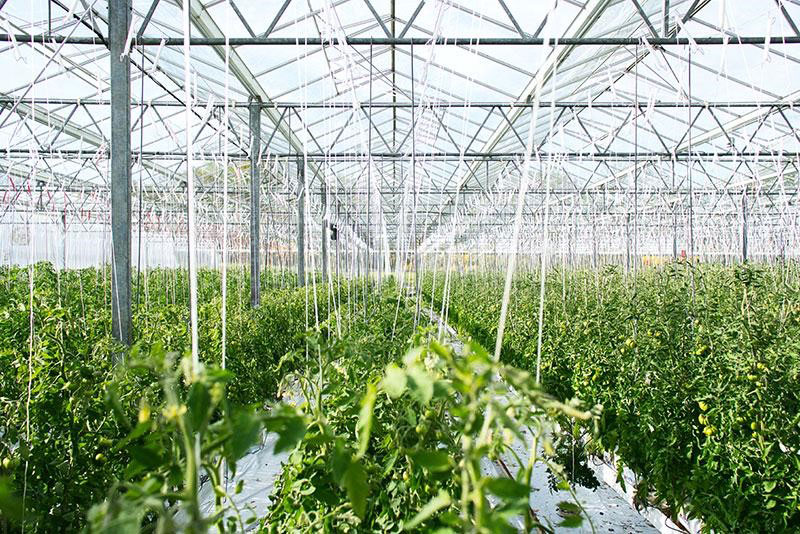
In the agricultural sector, polypropylene compression fittings are indispensable. They are used to connect mainlines and laterals in drip and sprinkler systems.
Their ease of disassembly is particularly useful for farmers who need to reconfigure their irrigation layouts between growing seasons.
Thanks to their chemical resistance, PP fittings are used in industrial settings to transport chemical solutions, slurries, and even cooling fluids. They provide a cost-effective alternative to expensive stainless steel or specialty alloy fittings.
The chlorine or other chemicals used in swimming pools can be corrosive to metals. PP compression fittings offer a non-corrosive solution for pool filtration systems and circulation pumps, ensuring a long-lasting, clear-water environment.
In green building projects, these fittings are used to connect collection tanks to distribution lines. Their ability to be installed quickly by DIY enthusiasts or professional contractors makes them a staple in sustainable water management.
If you’re searching for high-quality piping solutions, LESSO is a global leader. LESSO PP compression fittings are engineered to meet international standards, with various sizes and types available.
l Material: High-grade PP for maximum impact strength.
l Precision Engineering: Every compression coupling features a high-tensile structure to ensure the pipe remains locked under pressure.
l Eco-friendly: Reusable and recyclable.
Whether you are building an agricultural irrigation network or a domestic water system, LESSO provides the "fast and reliable" connection your project deserves. Contact LESSO now for a customized solution!
PP compression fittings represent a significant advancement in piping technology, offering a heat-free, reusable, and durable alternative to traditional ones. From agricultural irrigation to domestic water supply, these PP fittings ensure a secure connection that stands the test of time.
For your next project, choose LESSO's PP compression fittings for unmatched quality and ease of use.